
8 Key Battery Trends Shaping 2026
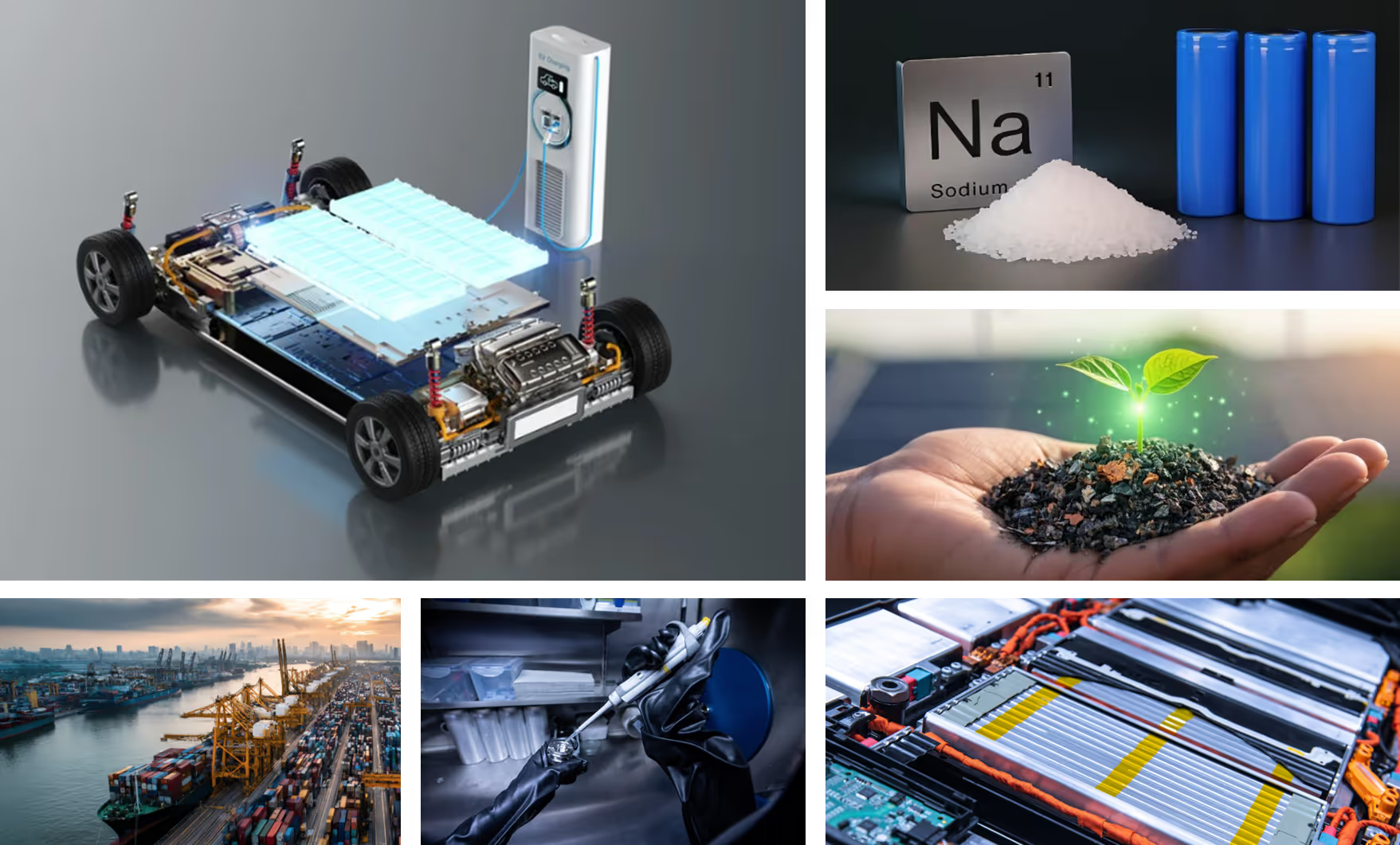
Battery innovation is accelerating, but not only at the cell level or in chemistry. From solid-state progress and alternative chemistries to structural battery designs, intelligent BMS software, and circular value chains, 2026 is all about understanding the "big picture." What does this mean for developers and OEMs?
+ Unsing synergies from network
+ Reducing complexity in development projects and standardizing processes
+ Evolve validation at an early stage
+ Use intelligent tools and smart software to develop future-proof system concepts
Get more insights into the eight main battery trends of 2026 and learn how they will transform the battery industry.
Trend 1: Solid-State Batteries Approach Industrialization
Solid-state batteries are moving closer to real-world applications. Higher energy density, improved safety, and fast-charging capabilities make them a key focus for development. For developers, this increases the need for robust testing, modeling, and validation strategies early in development.
Trend 2: Alternative Chemistries Gain Momentum
Beyond lithium-ion, sodium-ion batteries are gaining traction due to lower costs and reduced dependence on critical raw materials. They are particularly attractive for entry-level EVs and stationary storage.
Other chemistries, such as lithium-sulfur, remain promising for niche applications.

Trend 3: Structural Battery Integration (Cell-to-Pack & Cell-to-Chassis)
Battery design is shifting from modular packs toward structural integration. Cell-to-Pack and Cell-to-Chassis concepts reduce weight, increase volumetric efficiency, and lower system costs.
This trend is reshaping vehicle architecture and battery system engineering. Battery, BMS, and vehicle structure must be engineered and validated as one system.

Trend 4: Growing Demand for Long-Duration Energy Storage
The expansion of renewable energy drives demand for batteries with longer discharge durations. Stationary storage solutions are becoming a key growth market alongside electric mobility.
Safety, lifetime, and cost stability are the main design drivers.
Trend 5: BMS Intelligence Becomes a Competitive Advantage
Battery performance is increasingly defined by software. Advanced BMS algorithms enable smarter charging, thermal control, and performance optimization. Data analytics and AI tools are becoming standards in battery development. At PEM Motion, the intelligent ETA-Leveling BMS algorithm increases batteries’ lifetime up to 52%.
Trend 6: Sustainability and Battery Circularity
Sustainability is no longer optional. Recycling, second-life concepts, and reduced use of critical materials are central to future battery strategies. Regulation and customer expectations accelerate the shift toward circular battery value chains.

Trend 7: Localization of Battery Supply Chains
Geopolitical factors are reshaping battery production. Europe and the US are investing heavily in local cell manufacturing and supply chain independence. Those aspects influence technology choices, scaling strategies, and partnerships across the industry.
Different regulations, suppliers, and production setups require flexible system concepts. Standardized development processes combined with application-specific adaptation are key to scaling successfully.

Trend 8: Raw Material Pressure Accelerates Innovation
Rising demand for lithium and other key materials puts pressure on costs and availability. This reinforces interest in alternative chemistries, higher material efficiency, and improved recycling technologies.
Raw material strategy is becoming a core part of battery development decisions.

PEM Motion’s Conclusion
In 2026, battery innovation is no longer just about chemistry.
It is about understanding the “big picture” of battery system technology, lifecycle, development, and manufacturing processes, as well as regulatory requirements and global market dynamics.
Success depends on mastering all aspects while developing safe, validated, and future-proof products at the same time.
CONTACT THE EXPERT


.avif)