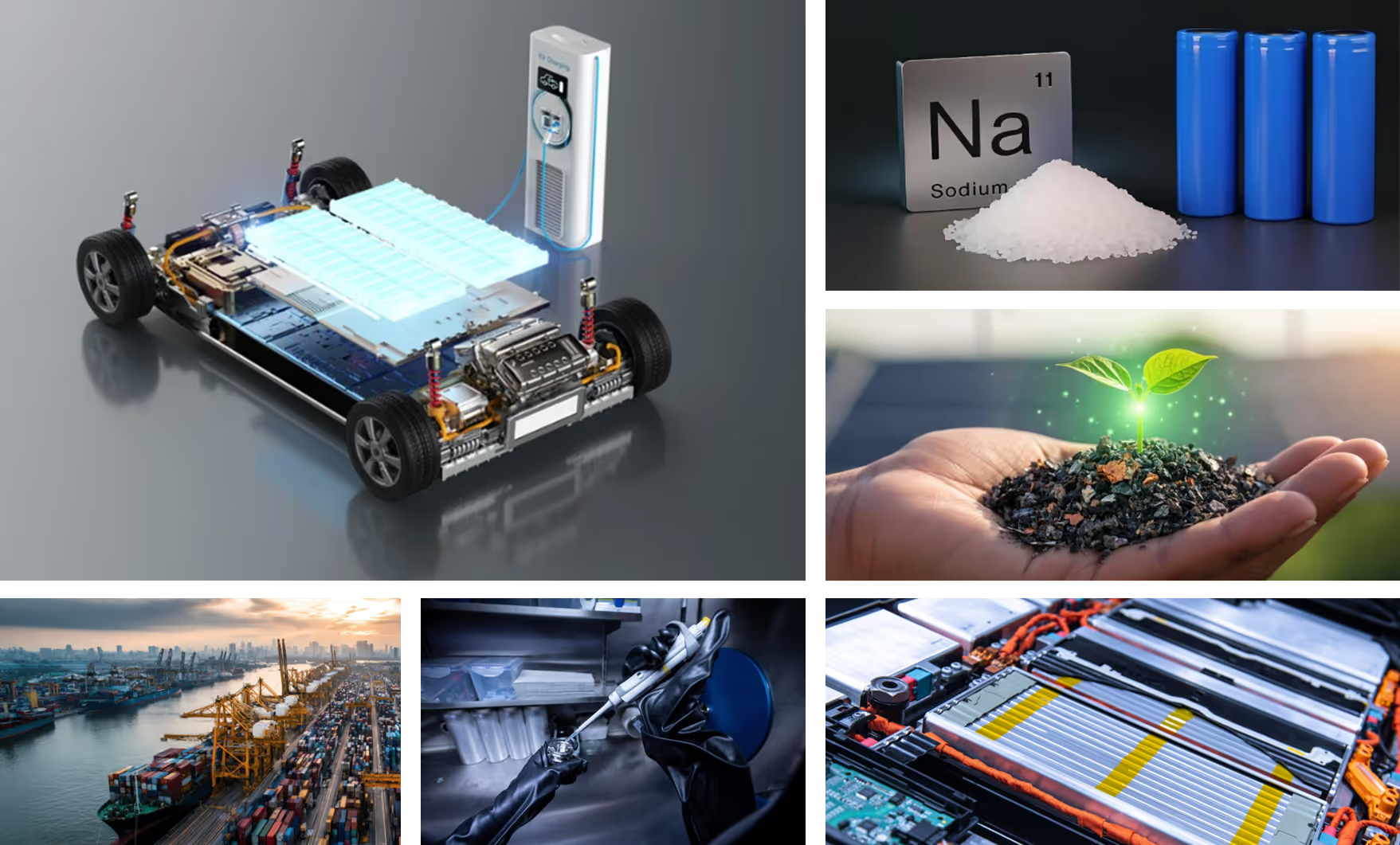
Parallel Operation of Na-Ion and Li-Ion Cells in Stationary Battery Systems
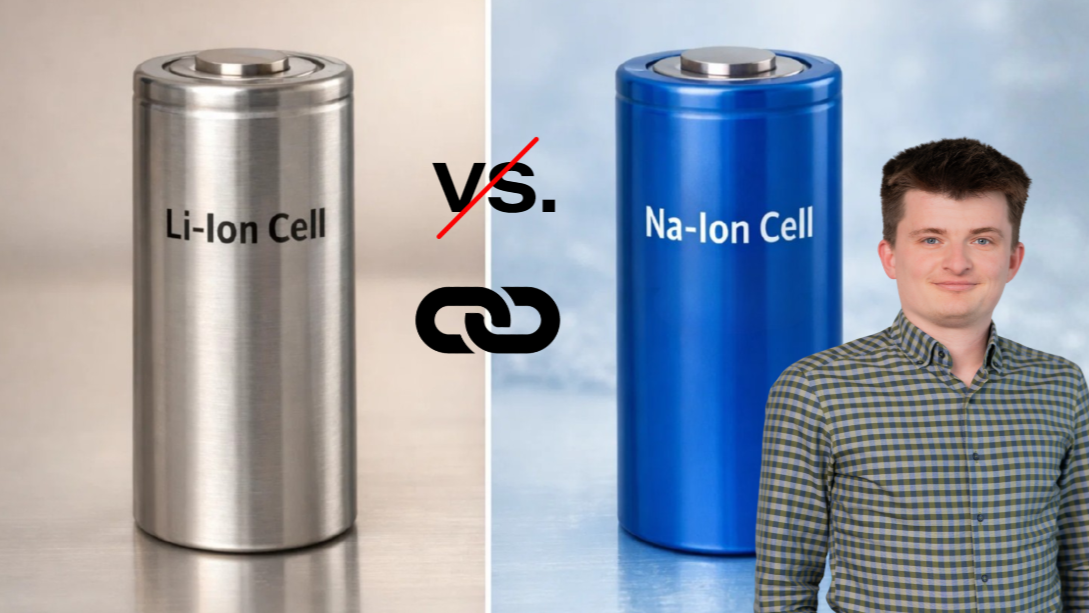
May 19, 2026
What happens when two fundamentally different battery chemistries are combined within a single energy storage system—not as a compromise, but to leverage the best of both worlds? This very question is currently driving one of the most exciting developments in stationary energy storage.
While lithium-ion batteries (Li-Ion) dominate the market with their high energy density of 150–270 Wh/kg and well-established manufacturing and supply chains, sodium-ion batteries (Na-Ion) are increasingly emerging as a serious alternative: lower material costs due to the virtually unlimited availability of sodium, superior low-temperature performance down to -40 °C, and cycle life of up to 10,000 cycles. However, neither technology alone fully meets the entire requirement profile of modern energy storage systems.
The parallel operation of both cell chemistries in hybrid battery systems promises to close this gap by combining the cost advantages and low-temperature robustness of Na-Ion cells with the high energy density and power capability of Li-Ion systems. Initial commercial applications such as the CATL Freevoy already demonstrate that this approach has moved beyond the laboratory stage. However, achieving this requires solving significant technical challenges—from voltage matching and thermal management to entirely new BMS architectures.
This article analyzes the challenges, solution approaches, and current state of the art.
I. Technical Challenges of Parallel Operation of Different Cell Chemistries
1. Voltage Differences as the Core Challenge
The fundamental challenge in operating Na-Ion and Li-Ion cells in parallel lies in their differing voltage characteristics. Na-Ion cells typically have a nominal voltage of 3.0–3.2 V, whereas Li-Ion cells operate at 3.6–3.7 V. This voltage difference leads to uncontrolled equalization currents between parallel strings, potentially resulting in overcharging, accelerated aging, and safety risks.
The operating voltage ranges further intensify this issue: Na-Ion systems generally operate between 1.5–4.0 V, while Li-Ion systems operate between 3.0–4.2 V. The overlap is only partial, making direct parallel connection at the cell level practically impossible without additional control technology.
This voltage incompatibility is the primary reason why hybrid systems rely on power-electronic decoupling—either through permanent voltage conversion during simultaneous operation or through controlled string switching during sequential operation.
2. Complex Temperature Dynamics
Na-Ion batteries exhibit significantly better low-temperature behavior than Li-Ion systems. While Na-Ion cells can discharge down to -40 °C and charge at temperatures as low as -30 °C, Li-Ion batteries are typically limited to an operating range between -20 °C and +60 °C.
These differing thermal dynamics require separate thermal management concepts and can lead to uneven power output under changing environmental conditions.
Especially for stationary systems in regions with extreme temperature fluctuations—such as grid storage systems in Scandinavia or desert environments—this asymmetry offers a strategic advantage. If loads are dynamically shifted toward the more temperature-robust string, overall system availability can be significantly increased.
3. BMS Complexity and Safety Requirements
Conventional Battery Management Systems (BMS) are designed for homogeneous cell chemistries. The parallel operation of different technologies requires hybrid BMS architectures capable of simultaneously managing different charging voltages, SOC characteristics, and aging behaviors.
The development of such systems is still in its early stages, as dedicated Na-Ion BMS solutions are only available to a limited extent.
The requirements for these new BMS concepts—from chemistry-specific cell monitoring to system-wide coordination between battery strings—run as a central theme throughout all subsequent chapters.
II. Technological Solution Approaches for Hybrid Battery Systems
The integration of different cell chemistries into a common battery system requires a fundamental decision regarding the operating philosophy: simultaneous operation or sequential operation.
1. DC-DC Converters for Voltage Matching (Simultaneous Operation)
The most promising solution for simultaneous operation of both cell chemistries involves bidirectional DC-DC converters, enabling continuous voltage adaptation between different battery strings.
In this configuration, the converter serves as the central interface between the strings. It transforms the output voltage of one string to match the voltage level of the other, allowing both chemistries to feed power into a common DC bus simultaneously.
Because Na-Ion cells operate at 3.0–3.2 V and Li-Ion cells at 3.6–3.7 V, the converter must compensate for this difference in real time across the entire SOC range.
The continuous power conversion inevitably creates converter losses. Studies on hybrid energy storage systems indicate typical DC-DC efficiencies of approximately 98%, meaning around 2% of transferred energy is lost as heat. At high continuous power levels, these losses generate additional cooling requirements.
However, the benefits are substantial:
- Full combined power of both battery strings is available at all times
- Dynamic load distribution optimizes each chemistry within its ideal operating window
- Redundant power supply increases overall system availability
Optimization algorithms can dynamically regulate power distribution so that total losses are minimized and aging progresses evenly across both battery types.
2. Separate String Architecture with Intelligent Control (Sequential Operation)
An alternative architecture uses separate battery strings for Na-Ion and Li-Ion cells coordinated through a higher-level control unit.
Unlike simultaneous operation, this configuration avoids permanent electrical coupling between strings. The control system activates the most suitable string depending on conditions such as temperature, load demand, or state of charge.
For example:
- Na-Ion strings can supply power at low temperatures
- Li-Ion strings can operate at room temperature under high load conditions
The main engineering challenge lies in seamless switching between strings.
Three critical problems must be solved:
Load Transfer
The outgoing string must reduce output power in a controlled manner while the incoming string ramps up simultaneously. Otherwise, temporary supply interruptions or power spikes may occur.
Voltage Transients
Different voltage levels between Na-Ion and Li-Ion strings create voltage jumps on the DC bus during switching. Without mitigation measures such as controlled power ramps or intermediate buffering, these transients may shorten the lifespan of sensitive electronic components.
Predictive Control
Advanced systems use predictive algorithms to anticipate switching events before critical operating conditions occur. These algorithms analyze temperature trends, load forecasts, and SOC profiles to initiate switching proactively.
The Chimera project at Cranfield University demonstrated that reliable multi-chemistry operation is possible even with relatively simple power electronics and infrequent switching intervals.
III. Practical Example
1. CATL Freevoy Hybrid System
A groundbreaking example of practical implementation is the CATL Freevoy Super Hybrid Battery System, already deployed in production vehicles.
The system utilizes CATL’s “AB Battery System Integration Technology,” combining Na-Ion and Li-Ion cells in mixed serial and parallel configurations.
The architecture primarily follows the separate-string principle while integrating DC-DC converters for voltage balancing between the chemistries.
Key innovations include:
SOC Calibration
The separate string architecture allows Na-Ion cells to serve as an SOC reference for the entire system, improving SOC accuracy by 30%.
Temperature Optimization
Na-Ion strings handle larger portions of the load at low temperatures, increasing cold-weather range by 5% and enabling operation down to -40 °C.
Advanced BMS Algorithms
CATL developed a “Full Temperature Range Accurate BMS Technology” featuring chemistry-specific algorithms for SOC estimation and degradation prediction.
These algorithms improve SOC accuracy by 40% and increase electrical utilization rates by more than 10%.
IV. Lifetime Estimation and Operational Optimization
1. Environmental and Load Dependency
The lifetime of hybrid battery systems is heavily influenced by intelligent load distribution between chemistries.
Na-Ion cells maintain capacity better at low temperatures, while Li-Ion batteries provide superior energy density at room temperature.
By shifting loads to the most suitable chemistry depending on operating conditions, overall system stress can be minimized and total system lifetime extended.
Current research indicates:
- Na-Ion batteries may achieve 2,000–10,000 cycles
- Li-Ion systems typically achieve 1,000–3,000 cycles
These differing aging characteristics require adaptive operating strategies.
2. Predictive Maintenance and System Optimization
Modern hybrid systems increasingly use data-driven lifetime prediction approaches.
Machine learning algorithms analyze degradation patterns of both battery types and optimize operational parameters accordingly.
These technologies enable predictive maintenance and maximize economic efficiency.
3. Hybrid BMS Strategies
Modern BMS concepts rely on multi-layer monitoring architectures comprising:
Cell Level
Individual monitoring of voltage, temperature, and current for each chemistry.
Module Level
Balancing between parallel cell groups of the same chemistry.
System Level
Coordination between different battery types and control of global performance optimization.
Chemistry-specific algorithms across all levels maximize system lifetime by accounting for differing degradation behaviors.
V. Conclusion: Technological Breakthrough with Challenges
The parallel operation of Na-Ion and Li-Ion cells in stationary battery systems marks a turning point in energy storage technology.
The technical challenges—voltage incompatibility, differing thermal dynamics, and BMS complexity—can be addressed through simultaneous and sequential operating philosophies.
As demonstrated by the CATL Freevoy system, real-world implementations benefit from intelligently combining both approaches.
The economic outlook is promising:
- Intelligent load distribution can lower total operating costs
- Na-Ion cells rely on abundant raw materials with more stable pricing than lithium, cobalt, or nickel
- Increasing production scale will make hybrid systems more economically attractive over time
Grid storage systems and industrial peak-shaving applications are likely to become the first major beneficiaries of this technology due to:
- High cycle requirements
- Occasional high-power demand
- Variable operating temperatures
Continued development of hybrid BMS architectures and increasing availability of industrial-grade Na-Ion components are expected to move this technology from pioneering applications to widespread adoption in the coming years.
CONTACT THE EXPERT

.avif)